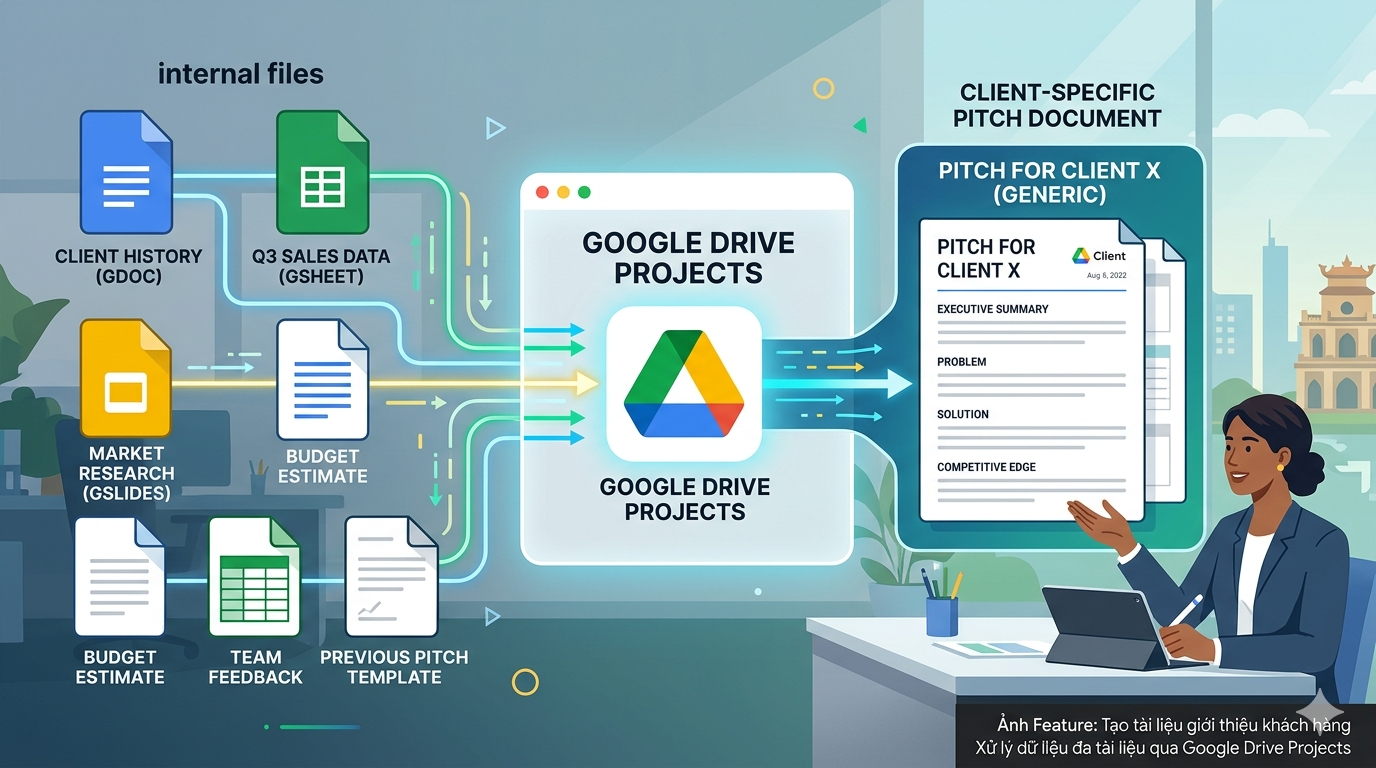
Create a client-specific pitch by cross-referencing product specifications, proposal
templates, discovery meeting notes, case studies, and pricing guidelines inside one
Google Drive Project — then use Ask Gemini to draft a comprehensive proposal.
Google Workspace · Gemini in Drive · Drive Projects
1. GOALS & ASSIGNMENT REQUIREMENTS
This article fulfills four requirements:
- Create a new Google Drive Project and aggregate relevant sources: product
specifications, proposal templates, and past meeting notes (plus supporting sales files). - Use Ask Gemini within the project to synthesize documents and generate a comprehensive
draft for a new client proposal. - Include specific analysis on how cross-file synthesis improves efficiency and accuracy
in routine sales processes. - Evaluate Gemini’s practical application in real proposal work (see Section 8).
NOTE: Gemini in Drive requires an eligible Google Workspace or Google AI plan.
New projects: https://drive.google.com or https://project.new
2. WHY AGGREGATE INTERNAL FILES IN ONE PROJECT
Per Google — Share your Gemini sources using Drive projects:
https://support.google.com/drive/answer/16684520
- A Project locks the source list for a specific deal or client — specs, templates, notes,
pricing, and case studies stay together across multiple Gemini sessions. - Sources are not moved; original Drive permissions stay unchanged.
- Sharing the Project shares the source list; each seller keeps private chat history.
Per Use Gemini in Drive for research & analysis:
https://support.google.com/drive/answer/16963068
- Gemini can connect information across files with citations — critical when proposal
claims must trace back to discovery notes or approved product language.
3. PROJECT SETUP: MERIDIAN RETAIL — CLIENT PITCH HUB
Project name: Meridian Retail — Client Pitch Hub
Client scenario: Meridian Retail Group (42 stores + Shopify Plus) needs a unified
analytics proposal before Q4 peak season.
Sources in the Project (5 files):
| File | Type | Role in synthesis |
|---|---|---|
| Product_Specifications | Doc/Sheet | Features, packages, implementation, differentiators |
| Proposal_Template_Internal | Doc | Required sections, tone, length |
| Meeting_Notes_Discovery_Meridian | Doc | Client pain points, budget, timeline, stakeholders |
| Case_Study_RetailCo_Approved | Doc | Approved proof points and quote only |
| Pricing_and_Discount_Guidelines | Doc/Sheet | List price, discount rules, deal-specific cap |
Local demo files (upload to Drive as Google Docs): GGdrive/Client Pitch Demo/Sources/
4. CREATE THE PROJECT & ADD SOURCES
Step 1 — Upload sources to Drive
Upload all five files; convert to Google Docs where needed; restrict to sales team.
Step 2 — Create Project
drive.google.com → New → New Project → name: Meridian Retail — Client Pitch Hub
Step 3 — Add sources in Ask Gemini
Add all five files to the Project source list (or Save as a project from an existing chat).
Step 4 — Lock scope
Turn off broad Drive/Gmail/Web search so the draft uses only approved internal sources.
5. SHARE WITH TEAM MEMBERS
| Role | Permissions in the Project |
|---|---|
| Editor | Chat with Gemini, add/remove sources, share project |
| Viewer | Chat with Gemini; cannot edit master source list |
IMPORTANT: Share the Project and all five source files with the same account executives,
solutions engineers, and deal desk reviewers.
NOTE — Sharing with another account:
- Invited users need file access plus an eligible Gemini in Drive plan.
- Without Gemini, share the Docs directly — they cannot use synthesis inside the Project.
- Do not share draft chat output externally until citations are verified against sources.
Checklist:
- Share all five source files (at least Viewer for AE; Commenter for legal/pricing reviewers).
- Share Project: Editor for deal owner; Viewer for supporting reps.
- Optional: Add expiration when deal closes or is lost.
6. ASK GEMINI — PROPOSAL SYNTHESIS & DEMO RESULTS
Primary prompt used for synthesis:
“Using all sources in this project, draft a comprehensive client proposal for Meridian
Retail following our internal template. Pull pain points and budget only from discovery
notes, packages and features from product specifications, pricing from guidelines,
and proof points only from the approved case study. Flag any section where sources conflict.”
Test summary table
| # | Focus | Result | Citations | Notes |
|---|---|---|---|---|
| 1 | Full proposal draft | Correct structure per template | Yes | All 8 template sections addressed |
| 2 | Pain points / solution map | Correct — quotes themes from discovery | Yes | No invented client facts |
| 3 | Commercial terms | Correct — Growth $38,640 net within budget band | Yes | Matches pricing guidelines |
Overall: Gemini produced a usable first draft in one session by cross-referencing five
internal files — cutting manual assembly time before AE edit and manager review.
— DEMO — SYNTHESIS PROMPT & GEMINI RESPONSE (SUMMARY) —
QUESTION:
Draft a comprehensive proposal for Meridian Retail using all project sources and our template.
GEMINI RESPONSE (structured summary):
- Executive Summary
- Meridian: 42-store retail + Shopify Plus; needs unified marketing and inventory analytics
before Q4 peak. - Recommend CloudFlow Growth package; Year 1 investment $38,640 after 8% authorized discount
(list $42,000). - Outcomes in 90 days: single weekly leadership view, target 40%+ reduction in manual reporting
(aligned to discovery goal; supported by RetailCo case study range).
- Understanding Your Business (from discovery notes)
- Pain points: Monday manual reconciliation across tools; distrusted dashboards; ~$120K holiday
stockout loss; leadership receives screenshot reports. - Goals: single source of truth in 6 months; pilot e-commerce then 10 stores; Azure AD SSO; US region.
- Decision team: Sarah Chen (champion), James Ortiz (IT), CFO approval over ~$45K.
- Proposed Solution (from product specifications)
- Modules: Data Hub (Shopify connector), Campaign Insights, Inventory Signals, Executive Dashboards.
- Implementation: 4–6 week standard onboarding — fits pre–Black Friday deadline.
- Security: SOC 2 Type II, SSO — addresses IT requirements.
- Commercial Terms (from pricing guidelines)
- Growth list $42,000 → 8% discount → $38,640 net Year 1 (within $35K–$50K band).
- Annual prepay and discount caps respected; Starter not recommended at this scale.
- Case Study (from approved RetailCo file only)
- 47% reporting time reduction; stockout rate 8% → 3.2%; approved quote included.
- Team & Next Steps
- Proposed CFO briefing within 2 weeks per discovery action items.
- Kickoff target to allow go-live before Q4 peak.
- Appendix
- SLA 99.5%+, support tier per Growth package.
Editorial note for sales team: Gemini flagged no conflict between discovery budget band and
discounted Growth price. AE must still verify names, dates, and discount approval in CRM.
— SUPPORTING QUESTIONS (OPTIONAL) —
Q: “List only pain points from discovery we should highlight on slide 2.”
A: Four themes with citation to Meeting_Notes — no fabricated metrics.
Q: “Which package and net price should we quote per guidelines?”
A: Growth at $38,640 Year 1 net — cites Pricing_and_Discount_Guidelines + Product_Specifications.
7. CROSS-FILE SYNTHESIS FOR SALES PROPOSAL WORKFLOWS
Cross-file synthesis lets Gemini read the template, discovery notes, specs, case study,
and pricing rules together — so the proposal draft reflects the same deal context everywhere.
Efficiency in routine sales processes
- One prompt replaces opening five Docs and copy-pasting into a master proposal Doc.
- New business reps follow the locked template automatically — fewer missed sections.
- Pre-CFO review: first draft in minutes; AE time shifts to storytelling and stakeholder strategy.
- Deal handoff: SE adds technical Doc to Project; AE re-runs synthesis without rebuilding from scratch.
Accuracy in routine sales processes
- Pain points and budget figures come from discovery notes only — reduces invented client facts.
- Product claims trace to Product_Specifications — avoids overselling unapproved features.
- Case study metrics limited to Case_Study_RetailCo_Approved — protects legal/compliance.
- Pricing stays inside discount authority — synthesis tied to Pricing_and_Discount_Guidelines.
Without cross-file synthesis, teams risk a polished template filled with generic copy that
does not match what the client said on the discovery call — or a price that violates deal desk rules.
8. PRACTICAL EVALUATION — GEMINI IN REAL PROPOSAL WORK (ASSIGNMENT)
Purpose
We evaluate whether Gemini inside a client-specific Drive Project is useful for real
proposal work — not a generic AI demo. Test deal: Meridian Retail — Client Pitch Hub.
What we tested
- Five internal sources aggregated in one Project.
- One primary synthesis prompt to generate a full proposal draft aligned to our template.
- Citation check on pain points, package, price, and case study claims.
Real-use evaluation table
| Sales task | Gemini output in practice | Efficiency | Accuracy | Verdict |
|---|---|---|---|---|
| First draft proposal | 8 sections populated from 5 files | High — hours → ~15–30 min draft | High after citation pass | Adopt for internal draft |
| Pain-point slide | Pulled discovery themes only | High | High — cited notes | Adopt |
| Pricing section | Growth + 8% discount within band | High | High — matched guidelines | Adopt with Deal Desk sign-off |
| Compliance | Used approved case study only | Medium — still need human read | High when sources locked | Adopt with marketing review |
What works in practice
- Cross-file synthesis matches how sellers actually work: many Docs per deal, one client outcome.
- Template adherence: Gemini followed Proposal_Template_Internal section order without a separate checklist.
- Discovery fidelity: Client quotes and budget signals came from meeting notes, not generic retail boilerplate.
- Commercial guardrails: Discount and package matched internal pricing file — reduces accidental policy violations.
Limitations in practice
- Not client-ready PDF: Requires AE tone edit, branding, and visual design export.
- Gemini license required for every collaborator on the Project.
- Stale sources: If discovery notes update after a call, Project must be refreshed or answers lag.
- Legal/finance sign-off unchanged — synthesis accelerates draft, not approval.
When we use it vs when we do not
USE for: internal proposal drafts, briefing docs, SE-AE alignment before CFO calls.
DO NOT USE raw output for: signed SOWs, contractual SLAs, or public pricing without human approval.
Team rating (internal, 1–5)
- Ease of setup per deal: 4/5
- Usefulness for proposal drafting: 5/5
- Trust after citation review: 4/5
- Fit for routine sales (not reporting analytics): 5/5 for new-business workflow
Conclusion: Cross-file synthesis in a client Project materially improves efficiency
(first draft speed) and accuracy (traceable, policy-bound claims) for our proposal process.
We will create one Project per active enterprise opportunity above $30K.
9. ORIGINAL IDEA FOR YOUR DEPARTMENT
“One Deal = One Drive Project”
- Template folder duplicated per opportunity: specs + template + notes + pricing + case studies.
- At discovery call end, AE uploads notes and adds files to the deal Project within 24 hours.
- All Gemini chats for that client stay context-bound — no cross-contamination with other accounts.
- When deal closes, archive Project as read-only; clone structure for next prospect.
Benefit: Sales managers audit citations on risky claims (pricing, ROI) before executive review —
without rebuilding proposals from five disconnected Drive folders.
10. REFERENCES
- Share your Gemini sources using Drive projects
https://support.google.com/drive/answer/16684520 - Use Gemini in Drive for research & analysis
https://support.google.com/drive/answer/16963068 - Google Drive: https://drive.google.com
- New project: https://project.new
- Source Document: https://drive.google.com/drive/folders/1bxMtEdWELcMBJT2z–hIJdrxny-XdW7T?usp=sharing